Projects
Introduction
The research group investigates methodological approaches to meaningfully integrate digital innovations (speech recognition, wearables, artificial intelligence) into health research, with a particular focus on multiple sclerosis [1][1a].
Key guiding questions in its research are: “How can new data modalities [2](e.g. sensor time series, speech) be combined with conventional research methods in a scientifically robust way?" [2a] and “What additional outcomes relevant to patients and healthcare providers can be derived from new data modalities?” [3] [3a]
Building on existing technologies, the team also develops tools that simplify the integration of digital technologies into research and teaching and make them usable for other researchers.
Other projects address the challenges and implications of digital transformation on research and healthcare delivery. These have resulted, for example, in best practices for improving complex interdisciplinary [5] and interprofessional collaboration in digital projects [5a].
Talk2UZH
Talk2UZH is a research infrastructure originally funded by the Digital Society Initiative, with the goal of bringing the voices of respondents more directly into online surveys. Concretely, Talk2UZH allows participants to speak their answers into a microphone and have them transcribed into text using an open-source model (Whisper-V3-Large) hosted on University of Zurich servers. Talk2UZH is multilingual and privacy-friendly: only transcripts are stored, but not the sound files. The speech functionality can be combined with standard survey question types, thus blending closed and open questions (e.g. comment fields) for deeper insights and better response contextualization.
We have shown in our evaluation study (preprint available soon) that, if correctly implemented, allowing participants to speak, results in longer answers and more informational content. In our view, this technology can help add some measure of qualitative depth to quantitative surveying, while lowering access hurdles for participants.
Talk2UZH has been deployed successfully several national and international studies. The Tallk2UZH project has also resulted in severalconference and workshop presentations and won awards . Reporting of the initial round of project funding is available on the following website:https://www.dsi.uzh.ch/de/research/projects/archive/dsi-lab-infra/talk2uzh.html
We are open and happy to receive inquiries to use our speech-to-text infrastructure to conduct surveys under: E-Mail / E-Mail
Project lead: Andreas Baumer
Funding: DSI Infrastructure Grant
PI : Viktor von Wyl
Gender & Life Course in Multiple Sclerosis (GeLiCo-MS)
A gender-based life course perspective to improve health determinants and disease management
Multiple sclerosis (MS) is a chronic neurological disease that affects women more frequently than men. Biological sex and social gender may influence the risk and course of MS, health behaviors, living circumstances, access to healthcare, disease management and health-related outcomes. However, these dimensions are often insufficiently explored in research and are rarely examined across the life course. This limits our understanding of observed sex- and gender-related differences and their translation into clinical practice.
The project ‘Gender & Life Course in Multiple Sclerosis (GeLiCo-MS): A gender-based life course perspective to improve health determinants and disease management’ investigates how biological sex and social gender shape the experiences and health outcomes of persons living with MS at different stages of life. The project examines sex- and gender-related aspects across disease trajectories and health outcomes. The findings will provide an evidence base for more personalized, equitable and gender-sensitive approaches to MS care, patient support and disease management.
Beyond MS, the project contributes to sex- and gender-sensitive research practices. This includes developing resources and advancing methodological approaches for analyzing the roles of sex and gender in health research.
GeLiCo-MS is embedded in the Swiss Multiple Sclerosis Registry (SMSR), a nationwide, longitudinal, patient-centered research initiative conducted at the Epidemiology, Biostatistics and Prevention Institute of the University of Zurich. The SMSR collects information directly from persons living with MS and actively involves them in shaping its research activities.
Further information:
About GeLiCo-MS
Swiss Multiple Sclerosis Society
Swiss Multiple Sclerosis Registry
Project lead: Viktor von Wyl
Funding: GeLiCo-MS is funded by the Swiss National Science Foundation as part of National Research Programme 83, “Gender Medicine and Health", grant number 227032.
Projekt lead: Enriqueta Vallejo Yagüe
PI: Viktor von Wyl
ClinO Fatique Investigation using Digital Outcomes (FIDO)
Fatigue is a common and debilitating symptom of many diseases. It impacts physical and cognitive function, emotional well-being, and overall quality of life. Despite affecting millions, it is currently mainly assessed using questionnaires, which can be limited by subjectivity and recall bias. Ultimately, this complicates diagnosis, treatment, and patient support. The lack of objective measures makes it difficult to support patients with fatigue adequately. Developing objective methods is essential for monitoring fatigue and assessing therapy effectiveness.
FIDO is an ongoing exploratory, multicenter, observational clinical trial investigating objective methods to measure and monitor fatigue in people with post-COVID-19 (Long COVID) and multiple sclerosis (MS) and includes a group of healthy volunteers for comparison. The study uses a smartphone application (the FIDO app) together with two wearable devices to continuously collect data on fatigue and its fluctuations during daily life, in order to evaluate the potential of digital, objective measures compared to standard assessments.
Participation lasts approximately eight weeks and includes two in-person visits along with a continuous data collection phase. At the initial visit, participants complete baseline assessments and questionnaires and are introduced to the study's digital tools. During the following weeks, participants wear two wearable devices continuously (24 hours a day) and use the FIDO app to complete short daily tasks (approximately 7 minutes every two days) and brief questionnaires (approximately 5 minutes per day). All participants collect a stool sample at home during weeks 4 and 8 for gut microbiome analysis. At the final study visit, participants repeat a subset of the baseline assessments, provide feedback on the digital technology used, and return the study devices.
For people interested in participating in our study, please reach out via email or telephone/WhatsApp (+41 77 414 11 74).
Further information:
HumRes66610 | SNCTP000006337 | BASEC2024-01878
Clinicaltrials.gov registration
HumRes registration
Project lead: Liliana Barrios
Funding: Innosuisse (108.672.1 IP-LS) and DSI Bridge Postdoc Grant
PI: Liliana Barrios
SpHeRe (Speech in Health Research): Multilingual exploratory analysis of health-related free text
Patient narratives, interview transcripts, open-ended survey responses, and other forms of qualitative health data provide rich information about lived experience, symptoms, coping, emotional change, and treatment-related concerns. However, manually analyzing large collections of texts is time-consuming and can make it difficult to identify recurring themes and patterns systematically.
The Speech in Health Research (SpHeRe) project aims to make computational text analysis more accessible to students and healthcare researchers. It is designed to facilitate the analysis of large collections of patient narratives and other qualitative health data by integrating multilingual processing, transparent outputs, and a privacy-oriented system design into a single platform.
SpHeRe is built as a browser-based system designed to support the structured and reproducible analysis of health-related free text in English, German, French, and Italian. It combines text preparation, anonymization of personally identifiable information, sentiment analysis, emotion detection, topic modeling, keyword and frequency analysis, summarization, and psycholinguistic analysis into a single workflow.
Researchers and students can use SpHeRe to explore text data, for example to identify patterns in patient experiences. By linking analytical outputs at the sentence, paragraph, and full-text levels, SpHeRe allows to examine how sentiment and emotions vary across topics, trace emotional changes throughout a narrative, and identify the passages supporting observed patterns. Findings are presented through interactive reports, charts, word clouds, and downloadable data files. All these features make SpHeRe a useful tool for more patient-centered research and healthcare improvement.
Project lead: Sofia Strukova and Jonas Fabian
PI: Viktor von Wyl
Funding: SpHeRe is financed by a grant from the Universitäre Lehrförderung (ULF) of the University of Zurich.
AIDAPT-CMR
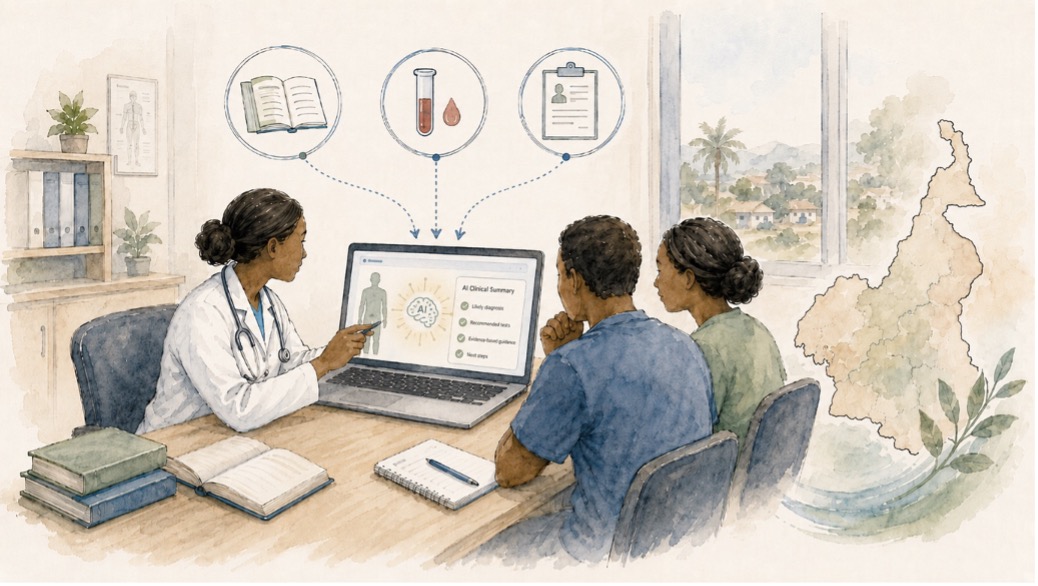
AIDAPT-CMR: Artificial Intelligence for Decision-support Adaptation in Primary care and Triage in Cameroon
Clinicians worldwide face increasing diagnostic complexity, expanding medical knowledge, and persistent gaps in access to specialist expertise. This is particularly true for resource-constrained settings, thus creating a need for scalable decision-support tools. In Cameroon and other sub-Saharan African countries, general practitioners often manage complex patients with limited diagnostic tools, constrained referral pathways, and variable access to up-to-date guidelines. This poses a challenge to prompt, accurate, and available care with minimal resources. Large language models are increasingly used for medical advice and clinical decision support. Yet, most have been evaluated in high-income settings, using exam-style benchmarks that do not reflect the realities of resource-limited primary care. The project will examine whether guideline-grounded large language model outputs can be useful, applicable, and safe for everyday primary-care decisions such as triage, first-line management, and referral.
This study will use synthetic clinical vignettes reflecting Cameroonian primary-care scenarios and compare LLM responses generated under different conditions, including baseline outputs and responses supported by retrieval-augmented generation using local and international clinical guidelines. Practicing general practitioners in Cameroon will evaluate the outputs through the MOOVE platform – a clinician-in-the-loop system for blinded, head-to-head assessment of medical AI responses.
Further information:
https://www.dsi.uzh.ch/en/current/news/2026/promotion-grant.html
Project lead: Sintieh Ekongefeyin
Funding: GRC Career Grant